May 30, 2011

Queen of the Sun


In case you didn't know yesterday, May 29th, was the day of the honey bee. A nation wide lobby is pushing to get this day recognized in as many provinces and municipalities as possible, and so far they are doing a pretty good job. As part of the celebrations Metro Cinema, in partnership with Lola Canola Honey, brought the documentary "Queen of the Sun" to Edmonton. Yesterday was the first screening, but there are 4 more. 7pm and 9pm, on May 30th and 31st. I would highly recommend that anyone with any level of interest in honey bees, or the plight of the honey bee go see this movie.

As for my personal thoughts on the movie, it did a very good job of touching base on all the things a person, who knows nothing about bees, should know about honey bees. It interviews a wide range of people from all over the world who are directly, or indirectly, affected by Colony Collapse Disorder. Noting that I am not, or never will be, a film critic I did find some of the cinematography off. There were also a few sections and cuts that seemed to be a bit out of place or off topic, but generally the flow of the movie was OK. The only other criticism I would have, and this may differ depending on who you talk to, was that most of the people they had tended to skew more to the Hippie side of things, for lack of a better word. Yes, I acknowledge that because of how honey bees are so closely intertwined with the very essence of nature there will be more than a few hippies, tree huggers, and environmentalists preaching the virtues of the bees. However, with the exception of one bloke in London most of the urban beekeepers came off on the extreme end of the scale, and even he was a bit eccentric but then again you do have to be a bit eccentric to become a beekeeper.

I was hoping to see more about the average person who falls in love with the bees once they are exposed to a hive for the first time. A teacher, a lawyer, or a child; people who don't necessarily practice yoga and eat only whole grains and vegetables. A powerful message that screams out that bees aren't dangerous and if you just stopped for a minute, allowing your childhood fear to melt away into the peaceful humming of an busy apiary on warm summer's day, you too could fall in love with these insects.

SO GO! See for yourself and find that love! There are 4 more screenings. Check out these links for more info. It is being shown downtown at the Citadel Theaters in Ziedler Hall.

METRO CINEMA

LOLA CANOLA HONEY

May 26, 2011

The Andrenids are amoung us!

Two weeks ago my wife and I were outside getting our vegetable garden prepped and seeded. While I was puttering around I noticed what I thought to be a few honey bees buzzing around. However, their behavior was very odd. They were slowly flying around the ground, occasionally landing to walk around a bit before taking off again. I began watching intently as my curiosity peaked. Laying on my stomach I followed the progress of one of these insects, as I landed in front of me I noticed that it was very close in appearance to a honey bee. The differences were subtle, while the head looked like a honey bee and it still had a fuzzy thorax, the hair was reddish yellow in colour, the abdomen was shiny jet black and smooth much like a fly. Another thing I noticed was that they were almost silent during flight, many times flying over my head without a sound. After a few minutes of observation, I noticed that one of the bees had permanently landed and was starting digging a hole into the dirt. Most curious. I ran inside to get my google on.

My instincts were right! It was a solitary species of bee native to Alberta. The Andrenid Bee, also known as "mining bees". These bees will dig a nest so they can lay an egg. They will then forage for pollen which they can stock up around the egg. Once there is enough food for the egg, the female will seal up the entrance and leave. While considered a solitary species, usually there will be many nests in close proximity giving the appearance of a colony.

This leaves me in a bit of a dilemma because the bees have setup home in the clay I placed around my house last year to grade. I had planned on compacting it and laying some topsoil and sod...can I do that now? Decisions, decisions.

Here are some pictures of the nests and bees. They took me a while to get and I bet my neighbours thought I was a bit nuts crawling around my front yard military style with camera in hand.


One of many burrows.


Bee inside a burrow, if you look closely you can see her face.


Posing for her close up.

May 18, 2011

Lazy Days

Hey Folks,

Just a quick update to let everyone know that I will be posting a few posts in the coming days. I've been a bit lazy in getting pictures off my camera and have lots to show everyone.

Everything from the new Top Bar hives that my friend and I have built and more recently installed a package of bees into, to my new local friends the Andrenid bees.

Be sure to check back soon.

April 11, 2011

Spring has arrived!

Hey everyone,

I've been meaning to post on how my installation of the candy board went last week, but I got busy with preparations for my Top bar hive building adventure. I'll squeeze it in with today's post.

So spring has finally arrived here in Edmonton. We've had almost 2 weeks of above zero highs and the majority of snow has melted away leaving brown/green spots of grass. Before that happened though, I went out to the bee yard to put my candy board on the hive so the girls have something to eat until local plants start to bloom. Everything went well, but I was surprised by the size of the cluster. I was expecting only a small corner or a quarter of the top to be bees, when I opened the cover they covered half of the frames. This created a bit of an issue because I now had to herd the bees around in order to place the candy board on top of the frames. I solved this by breaking the board up into smaller pieces. Next year, I will just forgo this issue by pouring the candy directly into a spare cover that way I can just replace the covers and be done.

Herding bees as I add pieces of candy board.

I headed out today to ensure that my hive wasn't bogged down in a lagoon of melting snow. Mario had expressed some concerns about his hives, but I think mine will do fine because I have them on cinder blocks. As expected, Mario's acreage was very soupy and I might actually have to purchase a pair of rubber boots for my next visit. A balmy 14°C meant a flurry of activity at the entrances of the hives, and the past 2 weeks of warm weather had melted all of the snow from around my hive providing easy access. With the easy access, I decided to unwrap the hives and do a little spring cleaning. Mario had an extra pollen patty as well, so I quickly popped the cover off to put it on top of the frames. The pollen patty will help the colony to start raising brood until they can start gathering larger quantities from blooming flowers. I was happy to see that the bees had been feasting on the candy I had added a week or so before.

Pollen patty, right side, and remnants of the candy board.

Once the hive was unwrapped I removed the entrance reducer and with a hooked piece of metal began fishing around the lower entrance. I was surprised by the amount of debris and dead bees that kept coming out with each swipe. I took a solid 15 minutes of scraping until the hook came out clean. The giant pile of corpses was quite a depressing sight, however it highlights the stark reality that beehives face during winter. So many bees give up their lives so the colony can survive and continue their genetic line.

Mounds of dead bees form a mass grave in front of the hive.

With my spring cleaning done, its back to playing the waiting game. When the weather gets even warmer I will be able to do a proper inspection to ensure everything is peachy keen. Until then, I sit and cheer on the dandelions....and maybe build a top bar hive or two.

BEFORE.

AFTER.

March 23, 2011

Mmmmmm Candy

Looks like old man Winter isn't quite going to give up so easy this spring. While temperatures are still fairly mild, it looks like there will be on and off flurries for the next week or so. It won't really get nice until early April. The bees have been stuck in their boxes for nearly 6 months now and food will be running low. On the bright side, it has been warm enough for them to break cluster and move around the hive to get at all their stored honey.

To help prevent starvation issues there are a few things a beekeeper can do. The most obvious is to provide a liquid form of food, either honey or sugar syrup. People that live in southern regions wouldn't have issues with this, but up here in the cold temperatures that syrup will quickly turn into a solid block of ice. Us northerners need a dry option that won't be so hard to access for the bees.

The Mountain Camp method is a simple and basic way to do this. With this method you add an empty super on top of the hive, place a piece of newspaper over cluster and then pour dry sugar on top. The newspaper acts as a barrier preventing the sugar from flowing freely down into the hive. The bees will then chew small sections away from the newspaper and feed off the sugar. The sugar also acts as a moisture absorbant preventing any condensation from dripping back onto the bees.

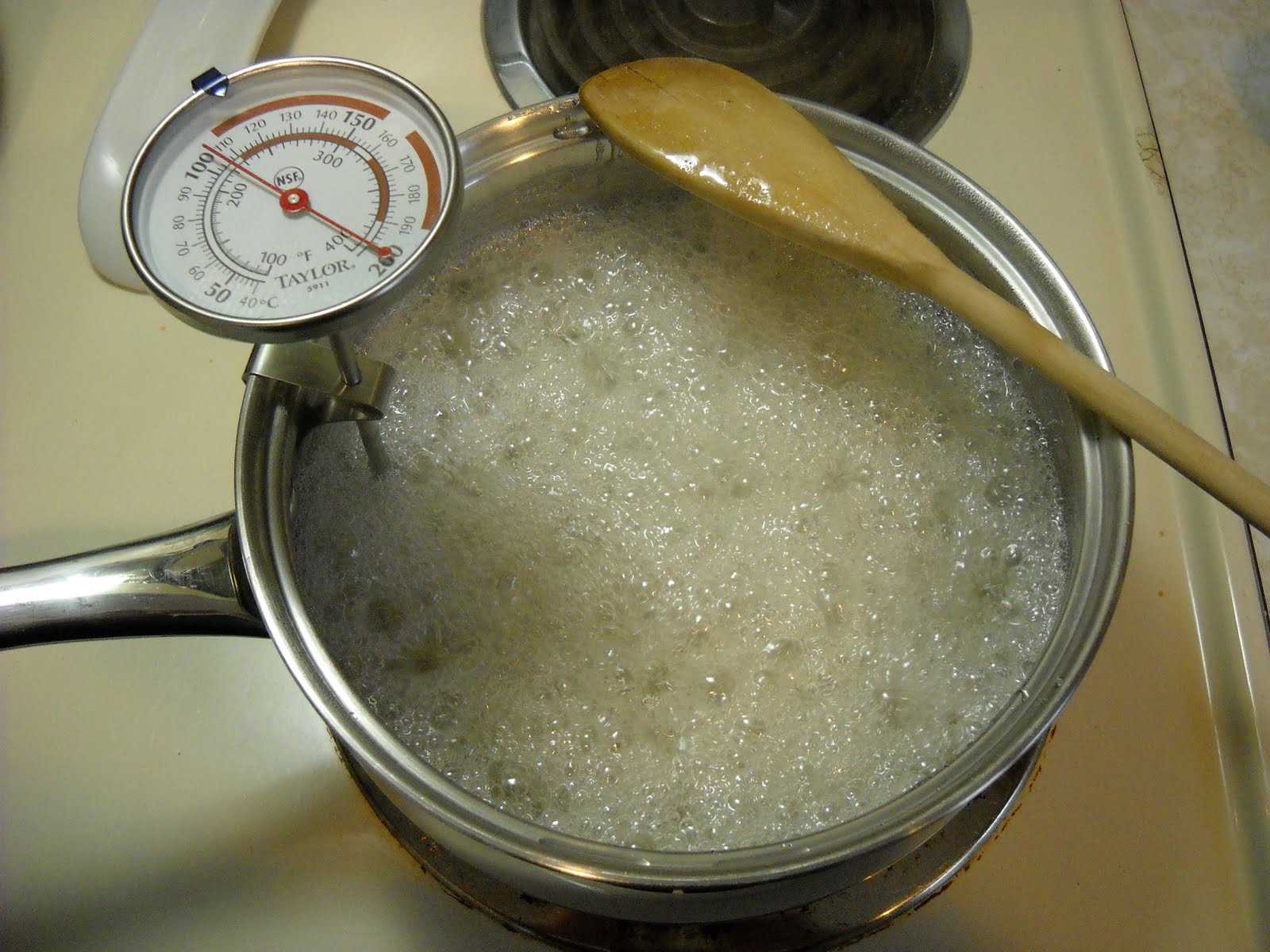
A slightly more complex method is to cook up some candy boards. To make candy boards, you take 2 cups of water and 5 pounds of sugar and cook them to approximately 240°F. After it cools it will result in a hard board that is much easier to work with than loose sugar. You can also add vinegar/acid to the process which will invert the sugars into glucose and fructose which is easier for the bees to digest. These boards also have the moisture absorption properties of the mountain camp method, but have the added benefit of being easier to remove once the bees start gathering their own nectar. Here is a quick run down of my candy making experience.


Materials Required. 2.5 lbs of sugar, 1 cup of water, candy thermometer, electric mixer, pot, and pan with parchment paper. (essential oils optional)


Add everything to pot on high heat. If you want to invert the sugar, add 1 Tbsp of lemon juice or cider/white vinegar.


Bring to boil at 240°F, the temperature will plateau at certain points like 230°F but given time it will slowly start to rise again.


Once 240°F is reached, remove from heat and let cool to around 200°F. Using the hand mixer, beat the mixture briefly every 2 or 3 minutes. Once the mixture starts to crystallize and is a smooth white semi liquid paste, pour into the sheet pan and let harden.

March 15, 2011

The Bee Dr. Is In

Good Almost-spring day to everyone!

I hope everyone is having an enjoyable end of winter. It's finally looking like there is light at the end of the tunnel here in Edmonton. We just made it past a nasty cold snap at the start of March and things are looking warmer for the next week or so. Hopefully it will melt all this snow we have, the snow is making things feel more depressing despite how much has already melted away


I was a tad concerned about the recent cold snap so when it was nice and warm yesterday, about 2°C, I went to ensure the girls were still alright. To my pleasure things looked great. They was a lot of activity at the top entrance as everyone was out enjoying the sun. I took this opportunity to test out a method of checking on hives during cold weather, despite being obvious from the activity they were doing extremely well. The method is meant more for checking during colder weather when there is no sign of activity at all. My nurse friend was kind enough to snag me a spare stethoscope. The premise is simple, using the stethoscope you listen for the gentle hum of the cluster. With my curiosity peaked, I tested it out yesterday. The hum was extremely loud due to all the activity but the method seemed to work well regardless of all the extra wrapping Mario had added to the hive. If it does get really cold again, I'll have to go test it out then to see if I can hear anything when the bees are clustered more tightly.

I also took the opportunity to find my smoker yesterday. I was searching all over my garage without a trace and then I remember I use to store it beneath the wood pile next to my hive at the bee yard, I must have left it there. If such was the case, I would have to remove it before the snow started to melt causing it to rust. The only thing that lay between it and myself was a waist high snow bank......


Let this be a lesson to always keep your smoker in a safe and dry place, although it did bring back fond memories of building snow forts as a kid.


The speckled landscape of bee poop....lots and lots of bee poop.


Girls gotta stick together as my wife helps out a stranded bee.

This week I'll be making some candy boards to put on top of the hive in the next week or so. Food stores will be getting towards the low end and the bees will need something to feed on until the snow melts and the dandelions bloom. Check back soon for pics and instructions on how to get that done.

I'd also like to thank my wife for another great artistic picture of me in the bee yard. Check it out on the main page, it will be a great alternate "About Me" picture during the winter months.

February 17, 2011

Warming Winter Days

Hey Folks,

So the weather has been quite variable as of late, swinging from 5°C to -20°C in a matter of days. However, a week of above zero temperatures was a great excuse to go out and see the bees. Hopefully some of the drifts had melted away allowing easy access to the hives.

When we arrived we noticed that Mario had managed to get his tractor out to the bee yard, making the trek so much easier. I was concerned to see that the city had already begun moving and grading dirt onto Mario's land. Mario's acreage is quickly being encroached on by developers and they approached him with a proposal to put all the top soil removed from their sites onto his land. At first I was concerned, but Mario said they are going to grade it properly and then in spring it will be covered in Alfalfa by the farmer who he leases the land to. It's a win win for Mario and the bees.


The hive was buzzing with activity in the warm sunny day. The bees were obviously happy to get out and stretch their wings, not to mention use the washroom. Most people don't know that bees will not defecate in the hive, so they can only relieve themselves when the weather permits. This was blatantly apparent with all the patches of yellow spots that littered the snow drifts in front of the hive. A good note for any urban beekeepers is to make note of which way your hive is aimed as I hear bee poop isn't the easiest of things to clean off, say, a car or patio furniture.

Unfortunately, on a sadder note, the good weather also means that newer born bees will also take the opportunity to get out of the hive. Without the proper flight skills they often end up landing on the snow which will slowly, if not surely, kill them. I was touched to see that when Mario came out to greet us, he took time to pick up some of these nurse bees and attempt to sheppard them into a hive. An extremely touching gesture akin to those baby duck videos that litter YouTube. If there is anything that can swing a person's mind as to the "voraciousness" of bees, it would seeing 2 grown men herding baby bees back home.

A nurse bee soaking up the rays on my finger, she did eventually take flight.

I had intended to remove the entrance reducer and using a bent coat hanger clear out the bottom of the hive of dead bees, however Mario had so thoroughly wrapped my hive it would have been very difficult to get it off. Also, there was much more activity than I was expecting and with the snow drifts around the hive there was no easy way to gain access without sticking my head right next to the top entrance. Without a veil that situation could be precarious. It appeared that the bees were doing a good job of cleaning the hive themselves though as all around the hive lay the bodies of fellow bees, it is quite astonishing how many bees die during the cold winter months.

We are starting to get into the spring prep months so check back soon for new posts on the activities I will be doing. These include building a top bar hive, making spring feed, and possibly even making my own pollen patties. Until next time, bee cool.