March 23, 2011

Mmmmmm Candy

Looks like old man Winter isn't quite going to give up so easy this spring. While temperatures are still fairly mild, it looks like there will be on and off flurries for the next week or so. It won't really get nice until early April. The bees have been stuck in their boxes for nearly 6 months now and food will be running low. On the bright side, it has been warm enough for them to break cluster and move around the hive to get at all their stored honey.

To help prevent starvation issues there are a few things a beekeeper can do. The most obvious is to provide a liquid form of food, either honey or sugar syrup. People that live in southern regions wouldn't have issues with this, but up here in the cold temperatures that syrup will quickly turn into a solid block of ice. Us northerners need a dry option that won't be so hard to access for the bees.

The Mountain Camp method is a simple and basic way to do this. With this method you add an empty super on top of the hive, place a piece of newspaper over cluster and then pour dry sugar on top. The newspaper acts as a barrier preventing the sugar from flowing freely down into the hive. The bees will then chew small sections away from the newspaper and feed off the sugar. The sugar also acts as a moisture absorbant preventing any condensation from dripping back onto the bees.

A slightly more complex method is to cook up some candy boards. To make candy boards, you take 2 cups of water and 5 pounds of sugar and cook them to approximately 240°F. After it cools it will result in a hard board that is much easier to work with than loose sugar. You can also add vinegar/acid to the process which will invert the sugars into glucose and fructose which is easier for the bees to digest. These boards also have the moisture absorption properties of the mountain camp method, but have the added benefit of being easier to remove once the bees start gathering their own nectar. Here is a quick run down of my candy making experience.


Materials Required. 2.5 lbs of sugar, 1 cup of water, candy thermometer, electric mixer, pot, and pan with parchment paper. (essential oils optional)


Add everything to pot on high heat. If you want to invert the sugar, add 1 Tbsp of lemon juice or cider/white vinegar.
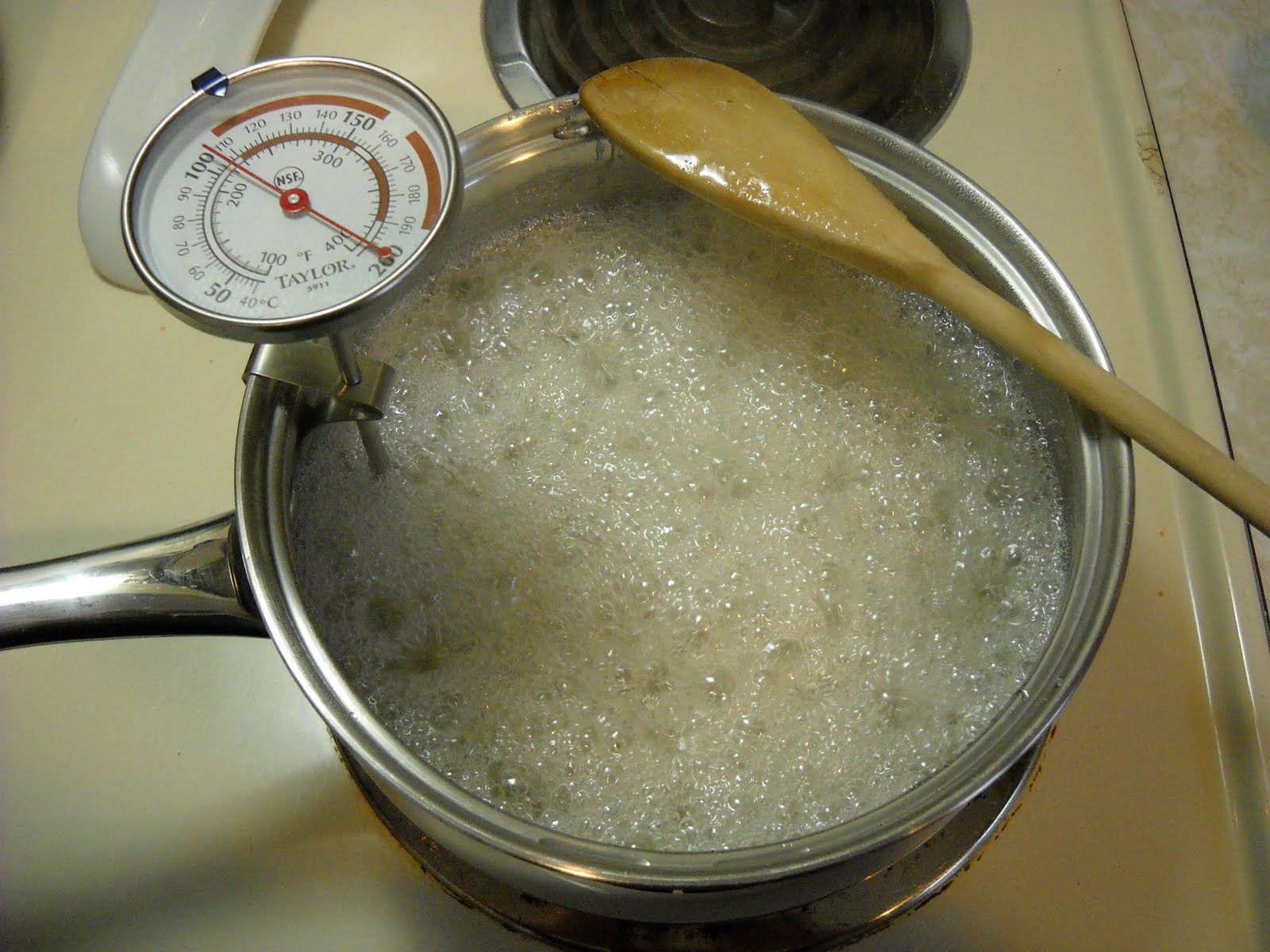

Bring to boil at 240°F, the temperature will plateau at certain points like 230°F but given time it will slowly start to rise again.


Once 240°F is reached, remove from heat and let cool to around 200°F. Using the hand mixer, beat the mixture briefly every 2 or 3 minutes. Once the mixture starts to crystallize and is a smooth white semi liquid paste, pour into the sheet pan and let harden.

March 15, 2011

The Bee Dr. Is In

Good Almost-spring day to everyone!

I hope everyone is having an enjoyable end of winter. It's finally looking like there is light at the end of the tunnel here in Edmonton. We just made it past a nasty cold snap at the start of March and things are looking warmer for the next week or so. Hopefully it will melt all this snow we have, the snow is making things feel more depressing despite how much has already melted away


I was a tad concerned about the recent cold snap so when it was nice and warm yesterday, about 2°C, I went to ensure the girls were still alright. To my pleasure things looked great. They was a lot of activity at the top entrance as everyone was out enjoying the sun. I took this opportunity to test out a method of checking on hives during cold weather, despite being obvious from the activity they were doing extremely well. The method is meant more for checking during colder weather when there is no sign of activity at all. My nurse friend was kind enough to snag me a spare stethoscope. The premise is simple, using the stethoscope you listen for the gentle hum of the cluster. With my curiosity peaked, I tested it out yesterday. The hum was extremely loud due to all the activity but the method seemed to work well regardless of all the extra wrapping Mario had added to the hive. If it does get really cold again, I'll have to go test it out then to see if I can hear anything when the bees are clustered more tightly.

I also took the opportunity to find my smoker yesterday. I was searching all over my garage without a trace and then I remember I use to store it beneath the wood pile next to my hive at the bee yard, I must have left it there. If such was the case, I would have to remove it before the snow started to melt causing it to rust. The only thing that lay between it and myself was a waist high snow bank......


Let this be a lesson to always keep your smoker in a safe and dry place, although it did bring back fond memories of building snow forts as a kid.


The speckled landscape of bee poop....lots and lots of bee poop.


Girls gotta stick together as my wife helps out a stranded bee.

This week I'll be making some candy boards to put on top of the hive in the next week or so. Food stores will be getting towards the low end and the bees will need something to feed on until the snow melts and the dandelions bloom. Check back soon for pics and instructions on how to get that done.

I'd also like to thank my wife for another great artistic picture of me in the bee yard. Check it out on the main page, it will be a great alternate "About Me" picture during the winter months.

February 17, 2011

Warming Winter Days

Hey Folks,

So the weather has been quite variable as of late, swinging from 5°C to -20°C in a matter of days. However, a week of above zero temperatures was a great excuse to go out and see the bees. Hopefully some of the drifts had melted away allowing easy access to the hives.

When we arrived we noticed that Mario had managed to get his tractor out to the bee yard, making the trek so much easier. I was concerned to see that the city had already begun moving and grading dirt onto Mario's land. Mario's acreage is quickly being encroached on by developers and they approached him with a proposal to put all the top soil removed from their sites onto his land. At first I was concerned, but Mario said they are going to grade it properly and then in spring it will be covered in Alfalfa by the farmer who he leases the land to. It's a win win for Mario and the bees.


The hive was buzzing with activity in the warm sunny day. The bees were obviously happy to get out and stretch their wings, not to mention use the washroom. Most people don't know that bees will not defecate in the hive, so they can only relieve themselves when the weather permits. This was blatantly apparent with all the patches of yellow spots that littered the snow drifts in front of the hive. A good note for any urban beekeepers is to make note of which way your hive is aimed as I hear bee poop isn't the easiest of things to clean off, say, a car or patio furniture.

Unfortunately, on a sadder note, the good weather also means that newer born bees will also take the opportunity to get out of the hive. Without the proper flight skills they often end up landing on the snow which will slowly, if not surely, kill them. I was touched to see that when Mario came out to greet us, he took time to pick up some of these nurse bees and attempt to sheppard them into a hive. An extremely touching gesture akin to those baby duck videos that litter YouTube. If there is anything that can swing a person's mind as to the "voraciousness" of bees, it would seeing 2 grown men herding baby bees back home.

A nurse bee soaking up the rays on my finger, she did eventually take flight.

I had intended to remove the entrance reducer and using a bent coat hanger clear out the bottom of the hive of dead bees, however Mario had so thoroughly wrapped my hive it would have been very difficult to get it off. Also, there was much more activity than I was expecting and with the snow drifts around the hive there was no easy way to gain access without sticking my head right next to the top entrance. Without a veil that situation could be precarious. It appeared that the bees were doing a good job of cleaning the hive themselves though as all around the hive lay the bodies of fellow bees, it is quite astonishing how many bees die during the cold winter months.

We are starting to get into the spring prep months so check back soon for new posts on the activities I will be doing. These include building a top bar hive, making spring feed, and possibly even making my own pollen patties. Until next time, bee cool.

January 11, 2011

Calling All Newbees!

Hey Beekeepers!

It's that time of year again when beekeepers start making preparations for the new season. It's actually a pretty hard thing to consider especially since we just got a dump of snow here in Edmonton and apparently there's more on the way.

I was trying to scheme with Patty and Eliese about setting up a Urban beekeeping course this spring, but both are fairly busy and I'm not really sure if there's time to effectively set one up. I know Eliese's courses in Calgary have been selling out like hotcakes, but she has the added advantage of beekeeping being legal within the city down there. I'm not entirely sure how many people I could round up for a course in Edmonton.

That said, I've been speaking with Jane regarding her acreage within the city and she's still excited and willing to allow some hives out there. I've emailed all my old classmates from Patty's class last year to see if people are interested in getting starting this. I've received a few responses which is great! I will also be holding a woodworking shop with Patty to build some Top Bar Hives for these new beekeepers.

If you live in the Edmonton, or surrounding area, and would be interested in getting started into beekeeping let me know! If you don't have understanding neighbours or just don't want to risk it, there is plenty of room on Jane's land. Just shoot me an email at newbeestelus.net and I'll get back to you with any information you might need!

January 3, 2011

New Year's Checkup

Happy New Year Beekeepers!

I hope that everyone had a fantastic Christmas and a happy new year. My wife and I had a great holiday and with the cold weather breaking for a brief period I headed out to see how my bees have been coping with the bitter cold -25 days we've been having lately.

The drive out to the acreage wasn't nearly as bad as I thought it might be. I assume this is because they roads we travelled on are all technically within city limits and are therefore plowed eventually despite being low volume. Another possibility is that because of all the housing construction out there the large vehicles have made short work of the snow.

We arrived to find Mario in his tractor plowing his driveway, one of the disadvantages of having an acreage is the long driveway you have to shovel in winter. As always we had a brief chat with Mario about how things have been. Fortunately for us Mario had attempted to plow a path out to the hives, but after almost getting stuck gave up the venture. Even though it wasn't complete it saved us from having to trek through some ugly drifts.


We arrived to a very quite and solemn looking hive. Mario had kindly placed a snow fence in the treeline behind the hive so the snow drifts weren't that bad near the hive. He had also placed a burlap skirt around the bottom of the hive to keep snow from getting under the hive. He was worried about the airspace below my hive because of the cinder blocks I am using as a hive stand. I indulged Mario as I have never really worried about it because everything I've read says it's not the cold temperature that will kill your bees but moisture, hunger, or disease. If anything the snow below the hive would act as an insulation anyways.


It took some effort to get closer to the hive as the snow was knee deep. As I neared the hive I noticed that the specks in the snow at the front of the hive weren't the tree debris I had initially thought them to be, they were dead bees.


Yesterday we had some really warm weather so my first assessment would be that the hive was active and doing some house cleaning, getting rid of the bees that have given their life in service to the hive. Another possibility would be that something or someone had come by and given the hive a good enough knock to send out a defensive force, but seeing as there weren't any type of visible tracks near the hive I ruled this out. I am taking these dead bees as a sign that the hive is in exceptional health as they are still performing hive duties when the weather permits. Another positive sign is that the plastic covering the top entrance had some condensation on it meaning that there is still warm moist air coming out.

I briefly cleaned the lower entrance as some ice and snow had built up blocking any sort of ventilation. I have read that you can increase ventilation by using a grill type entrance device instead of a solid piece of wood. As I'm not sure if this is just for warmer climates I'll do more research on the subject and let you know what I find.

Until my next post, stay warm and stick to those resolutions!

December 19, 2010

Winter Reading

Just touching base so people know I'm not hibernating like my bees. I am still very much active in my beekeeping hobby.

Up until last week the winter we'd been having a fairly mild winter up here in Edmonton. Things took a change for the worse as we were hit with a foot of snow and some cooler temperatures. I was planning on checking in on the bees sometime this month but seeing as my car is having troubles getting around the city I hardly think country back roads would be kind to me.

To pass the time I have been reading forums and checking out Phil Chandler's webpage. Phil specializes in top bar hives. A few months back Patty approached me about setting up a top bar workshop for everyone in Edmonton she could find that would be interested in starting some top bar hives. Top bar hives haven't really been used in North America since most commercial operations use Langstroth hives. With the increase focus on natural beekeeping many new beekeepers are looking at top bars as a way of bucking the trend, regardless of benefits or draw backs. Currently Eliese with ABC in Calgary has been really promoting the top bar hive and the response has been great. With beekeeping being "legal" in Calgary many beginner course has been selling out as people are drawn to this new hobby. Hopefully Patty and I can start getting things rolling here in Edmonton.


In November I received "Natural Beekeeping" by Ross Conrad from my in-laws for my birthday. I had heard about Ross while browsing around forums, so I had put the book on my list. After finally getting through it, I had only been reading it during my Saturday work shift, I am extremely glad to have done so. Ross is very straight forward to his ideas on organic beekeeping, while not being too pretentious or sounding too granola. He presents both sides of the story with pros and cons of both. His personal experimentation and trials are very well explained and illustrated. I would highly recommend this book to anyone considering trying to go organic or even just more nature friendly.

Along with preparation for a top bar hive workshop this winter I also still have to get around to making my beeswax lip balm. I'm such a procrastinator.

November 13, 2010

Winter Storage Issues

My lord it's been a long time since my last post. Things really do slow down for beekeeping with the onset of cooler weather. I hesitate to say winter yet because we here in Edmonton have been fortunate enough to not have any snow!

My bees have been nicely put to bed for winter. Mario had some extra winterization material so he graciously let me use it. Basically the hive is first wrapped in some roofing paper and a piece of 2" thick Styrofoam is placed on top. Then Mario has made some custom sheaths that provide a protective entrance that slips over the top of the hive. Once all of this is placed onto the hive it gets a final wrapping of bungee cord to ensure nothing blows away. Here is what the final winterized hive looks like:


Although there isn't much to do with the hive during winter there is plenty of other things to keep me busy. Some of the issues that beekeepers face during winter is storage of all the extra frames of wax and supers. Because I crushed and strained my frames of honey I'm glad that I don't have any extra wax frames. Large producers have to be concerned with pests that like to use these frames for food or nesting. Wax moths can make quick work of destroying nicely drawn frames. Ants are always a pest and I have even had to ward them off in my garage. I wasn't however prepared for mice. Mice like to make nests in stored supers and also in active hives. If you don't reduce the entrance of the hive mice will take advantage of the warmth generated by the bees. The bees are too concerned with keeping warm to chase the mice out, as the mice get comfortable they will start chewing up all the wax.

While organizing my equipment I found this


I would assume it was either trying to find some place to sleep or was trying to eat the spilt honey. Unfortunately I think it got entombed in the honey and subsequently died there. I will save everyone the tale of removing a soft squishy mouse encased in taffy like honey.....it wasn't pretty. I've since properly stored my equipment to hopefully avoid such death traps.

I'll try to update everyone with any interesting information about beekeeping throughout the winter.